🤯 Poles in Flux: Magnetic North Sprints to Siberia, Ice Hides Lakes, Arctic Shrinks
by OMG[facts]
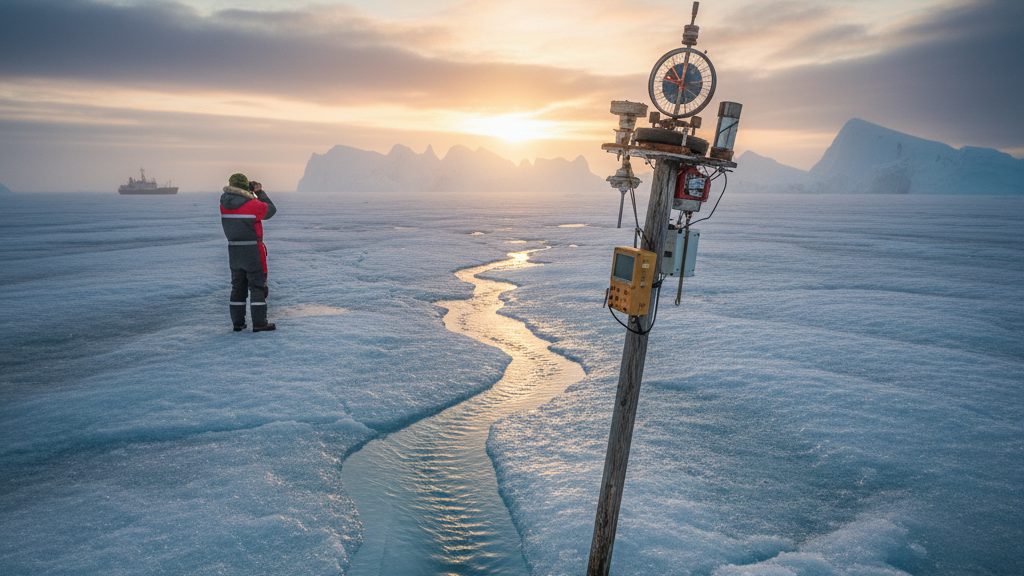
Earth's geographic poles mark where the axis of rotation meets the surface and have long served as key reference points. The polar regions also include the magnetic field generated deep inside the planet, the ice sheets of Antarctica, and the sea ice of the Arctic Ocean. These features are commonly imagined as fixed and straightforward parts of the globe.
Magnetic poles neither fixed nor opposite
[01] Since the first in-situ measurements in 1831 in the Canadian Arctic, Earth's north magnetic pole has accelerated toward Siberia, a shift scientists attribute to elongation of a magnetic flux lobe in the outer core.
[02] Earth's north and south magnetic dip poles are not currently antipodal and therefore fail to occupy opposite geographic positions on the planet.
Miles of ice conceal lakes at the melting point
[03] Ice at the geographic South Pole is 2,810 metres thick; borehole temperatures recorded to 2,345 metres, only ten kilometres from a radar-mapped subglacial lake, indicate the lake water sits at the pressure melting point.
[04] Four kilometres of ice conceal Lake Vostok, a 2,000-cubic-kilometre subglacial body comparable in volume to Lake Ontario, whose floor remains at melting temperature despite surface readings near minus 60 degrees Celsius.
[05] One of nearly 400 Antarctic subglacial lakes, Lake Vostok has been buried for 15 million years and its accreted ice, sampled 3,590 metres down, contains 2.8 × 10³ to 3.6 × 10⁴ microbial cells per millilitre.
Arctic sea ice drops into a new lower state
[06] Between 1979 and 2024 Arctic summer sea-ice extent declined 12.1 percent per decade against the 1981–2010 baseline, a yearly loss of 78,000 square kilometres—an area almost the size of South Carolina.
[07] Satellite observations reveal a regime shift in September Arctic sea-ice extent in 2007, after which the previously linear decline gave way to a new, persistently lower state.
[08] Harp-seal pups need at least twelve days of stable sea ice to complete nursing, yet North Atlantic breeding-habitat ice has declined throughout the satellite era, elevating long-term pup mortality risk.
The poles turn out to be defined by drift, hidden water, and ice that no longer matches the static picture.
[sources]
- https://arxiv.org/abs/2010.11033
- https://www.bbc.com/news/science-environment-52550973
- https://arxiv.org/pdf/2010.11033
- https://www.ncei.noaa.gov/products/wandering-geomagnetic-poles
- https://agupubs.onlinelibrary.wiley.com/doi/full/10.1029/2020JA028513
- https://www.pnas.org/doi/10.1073/pnas.082238999
- https://pmc.ncbi.nlm.nih.gov/articles/PMC122982/
- https://pubmed.ncbi.nlm.nih.gov/11077478/
- https://www.cambridge.org/core/journals/antarctic-science/article/coldloving-microorganisms-in-antarctic-glaciers-a-review-of-south-shetland-archipelago-glaciers/2C79DF5E418B8AB317A42D49670DB788
- https://pubmed.ncbi.nlm.nih.gov/10591642
- https://www.climate.gov/news-features/understanding-climate/climate-change-arctic-sea-ice-summer-minimum
- https://agupubs.onlinelibrary.wiley.com/doi/full/10.1029/2024GL114546
- https://nsidc.org/learn/parts-cryosphere/sea-ice/why-sea-ice-matters