🤯 Adult Tennis Transformation: Rewiring Motors, Managing Overuse, Mastering Tactics
by OMG[facts]
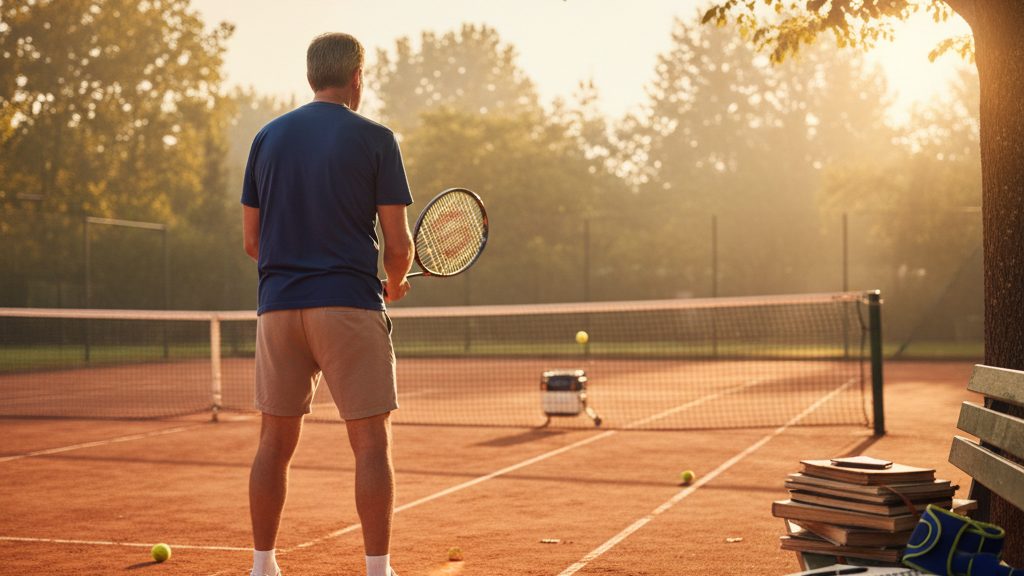
Adults who want to become advanced tennis players must acquire new motor skills on a court that also stresses the shoulder and elbow. The mature nervous system can still reorganize around those skills, yet the same hours of play produce a different injury profile than they do in juniors. Researchers have therefore examined both the neural basis of late skill learning and whether cognitive rather than purely physical practice can improve on-court results.
Adult brains still reorganize around new tennis skills
[01] Brain imaging studies support a model of cerebral plasticity in both the cortico-striatal and cortico-cerebellar systems of the adult brain while learning new motor skilled behaviors.
[02] Learning a motor sequence over several days is accompanied by an increase in the size of motor maps and in corticomotoneuronal excitability.
[03] Sport-specific cortical reorganization has been documented in tennis players, and this use-dependent plasticity constitutes the neural substrate of skill acquisition.
Injury rates and rotator-cuff tears rise sharply in adults
[04] Tennis injury incidence ranged from 2.1 to 3.5 per 1000 hours in juniors but reached as high as 56.6 per 1000 hours in adults according to a systematic review.
[05] Injury prevalence among adult recreational tennis players may be greater than 50 percent, and commonly encountered upper extremity conditions include rotator cuff injury and epicondylitis of the elbow.
[06] Most rotator cuff injuries in tennis players are partial-thickness articular-sided tears, whereas full-thickness tears tend to occur in older-aged players.
Cognitive skills training versus extra stroke practice
[07] Researchers studied whether multidimensional perceptual-cognitive skills training including situational awareness, anticipation, and decision making improves on-court performance in older adult tennis players compared with physical training of strokes and footwork.
The same adult brain that can still rewire for tennis therefore has to do so under a far heavier injury burden than juniors ever face.
[sources]
- https://pubmed.ncbi.nlm.nih.gov/15831397
- https://www.mdpi.com/2076-3425/16/7/694
- https://www.cell.com/neuron/pdf/S0896-6273(11)00918-4.pdf
- https://www.mdpi.com/2075-4663/13/10/336
- https://pmc.ncbi.nlm.nih.gov/articles/PMC7661672
- https://journals.sagepub.com/doi/abs/10.1177/19417381251387672
- https://upload.orthobullets.com/journalclub/free_pdf/25667400_Tennis_Injuries__Epidemiology,_Pathophysiology,.6.pdf
- https://pubmed.ncbi.nlm.nih.gov/17968049