🤯 The jobs our kids will hold haven't been invented yet. So why are we still teaching them like it's 1985?
by OMGFacts Team
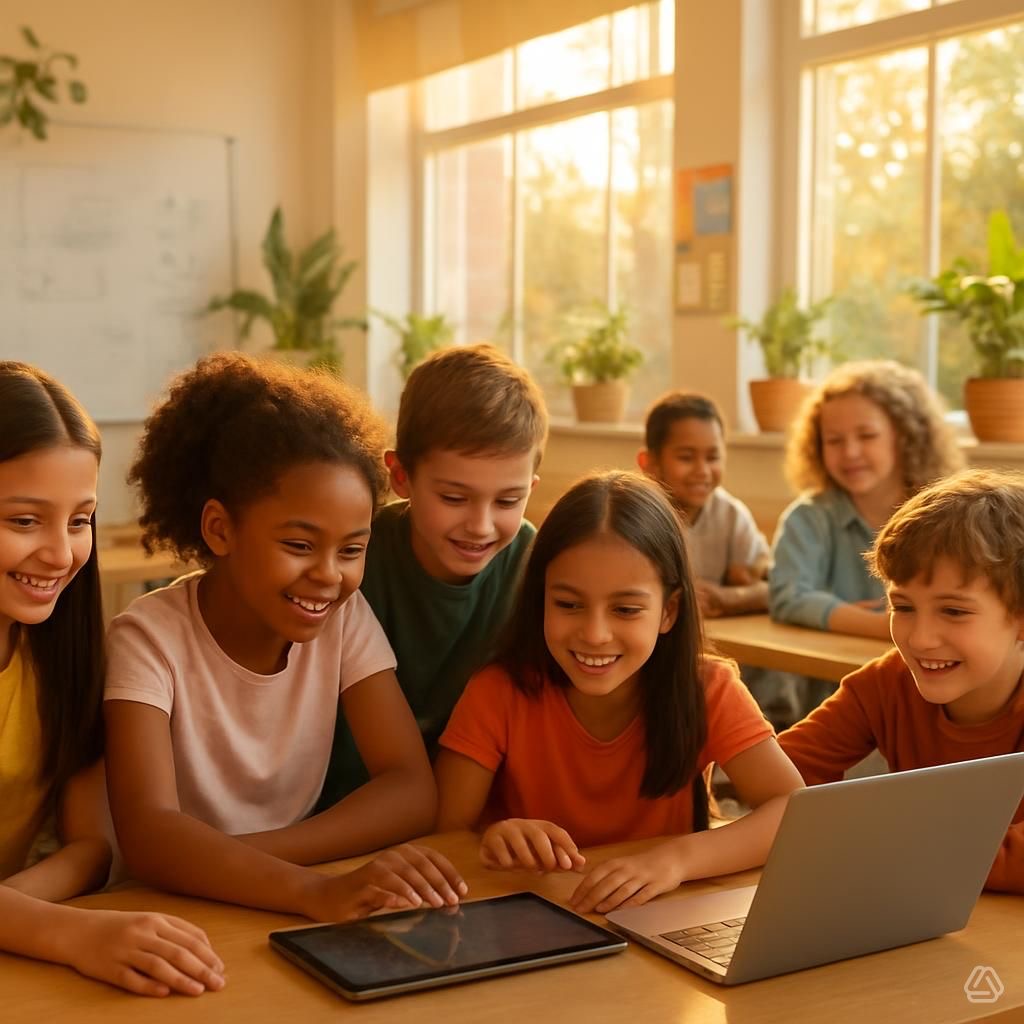
Consider this: the World Economic Forum estimates that roughly 65% of children entering primary school today will eventually work in jobs that don't yet exist. Meanwhile, McKinsey projects that AI and automation could displace up to 375 million workers globally by 2030. And yet, walk into most American classrooms today and you'll find something remarkably familiar — rows of desks, a teacher at the front, standardized tests, and a curriculum designed to sort students into a workforce that is rapidly disappearing.
The industrial-age school model was built with a purpose: produce reliable, compliant workers for factory floors and corporate hierarchies. Memorize facts. Follow instructions. Pass the test. Get the job. For over a century, that contract held. But artificial intelligence has shattered it.
Today, AI can write code, draft legal briefs, analyze medical images, and generate marketing copy — tasks that once required years of specialized training. What it cannot do, at least not yet, is think originally, lead with empathy, navigate ambiguity, build real relationships, or solve problems no one has seen before. Those are the skills that will define the next generation of human value. And they are precisely the skills most traditional schools are worst at teaching.
A small but growing number of private schools across the United States are refusing to accept this mismatch. They are redesigning education from the ground up — not tweaking the existing model, but asking a more fundamental question: What does a child actually need to thrive in a world shaped by AI? Their answers are producing some of the most provocative, exciting, and results-driven schools in the country.
Why Schools Resist Change
Before exploring the innovators, it's worth understanding the forces working against them — because the resistance to educational change is real, powerful, and in some ways rational.
Schools are subject to a complex web of accountability structures built around standardized tests, state curriculum standards, and seat-time requirements that were designed for a different era. Teachers, many of whom were trained in and succeeded under the traditional model, are understandably skeptical of unproven alternatives. Administrators fear liability, parental backlash, and the political risk of diverging from the norm. And school boards are elected institutions, meaning they respond to the median voter, not the educational vanguard.
There is also the inertia of familiarity. Parents evaluate schools based on the education they themselves received. If a school looks like what they remember — homework, grades, AP courses — it feels safe. Schools that don't look like school can seem risky, even irresponsible, to parents who aren't sure what success looks like without a letter grade to point to.
The result is a system that optimizes for the wrong outcomes: test performance over curiosity, compliance over creativity, content delivery over skill development. As education researcher and Stanford professor Dan Schwartz has argued, schools must grapple urgently with the question of what it means to be human in an AI-shaped world — and most are not yet asking it seriously.
The schools below are asking it every day.
1. Alpha School — Austin, TX (and 22 Campuses Nationwide)
The Radical Premise: What if students could master core academics in two hours a day, and use the rest of school for the things that actually matter?
Alpha School, founded in 2014 by Mackenzie Price, is perhaps the most discussed and most controversial school in America right now — and for good reason. Its model is a direct challenge to virtually every assumption of traditional education.
Every morning, students at Alpha spend one to two hours working with an AI-powered, fully personalized learning platform that adapts in real time to each child's pace and mastery level. The curriculum draws on best-in-class software including Khan Academy, Membean, Mentava, and MobyMax, combined with Alpha's own proprietary platform. The AI continuously assesses what each student knows and doesn't know, then adjusts accordingly — delivering mini-lessons, accelerating through mastered content, and looping back on concepts that haven't stuck. Every student is essentially receiving one-on-one tutoring from a system that never gets tired, never has 25 other kids to manage, and never moves on before the child is ready.
The adults in the room are not called teachers. They are called guides — and they are paid six-figure salaries to do something no algorithm can: connect, motivate, inspire, and coach. Each student receives at least 30 minutes of one-on-one time with their guide every week.
Afternoons at Alpha look nothing like a traditional school. Students work on projects, develop financial literacy, practice public speaking, learn coding, engage in entrepreneurial challenges, and explore their individual passions. One Alpha alum, Kate Liemandt, went on to score 1600 on the SAT and attend Stanford, where she told classmates she hadn't had a traditional teacher since fourth grade. She finished all of her high school math content as a sophomore.
The data Alpha reports is striking: students score in the top 1–2% nationally on the Measures of Academic Progress exam, and in internal surveys, 94% of students say they love school.
It should be noted that Alpha's claims rely on internal data that has not yet been independently peer-reviewed, and critics note the inherent difficulty of comparing an elite-tuition student population to national averages. Alpha also charges steep tuition — ranging from $40,000 to $75,000 per year depending on campus — which sharply limits access. The school has applied for public charter status in multiple states and been denied in several, with Pennsylvania's Department of Education calling the model "untested."
But "untested" cuts both ways. The traditional model has been tested for 150 years and is producing graduates who are chronically disengaged, ill-equipped for the modern workforce, and — in Alpha's own framing — prepared for jobs that no longer exist.
Alpha is now one of the fastest-growing school networks in the country. As of 2026, it operates 22 campuses across the United States and is actively expanding into major American cities as suitable locations are secured. The pace of that expansion is itself a signal: Chicago opens in fall 2026, taking over the former GEMS World Academy building in Lakeshore East and offering K-8 education — a significant milestone for the Midwest. The Bay Area is already operational, with a San Francisco Marina campus and growth into Palo Alto and the East Bay driven by surging demand. Virginia, New York City, Phoenix, Houston, Fort Worth, and Santa Barbara are either open or in development. Tuition varies significantly by market — from around $10,000 in more affordable Texas locations to $65,000–$75,000 in major coastal cities — and the school has stated an ambition to make the model more broadly accessible over time. For families curious whether Alpha is coming to their city, the network's website tracks upcoming locations as facilities are confirmed.
"There is such a huge advantage when students can be met at the level and pace of learning that is right for them. We recognize that there is a huge mountain of challenges in a large public school system. What I hope Alpha can be is an example — an inspiration — and help families understand that this model of education can work." — Mackenzie Price, Alpha School founder
2. High Tech High — San Diego, CA
The Radical Premise: What if the entire school were built around work that actually matters?
High Tech High (HTH) has been reimagining education since it opened its doors in 2000, founded on a simple but revolutionary conviction: students learn best when they are creating something real. Everything at HTH is organized around this idea.
There are no textbooks. There are no AP courses. There are no traditional tests in the conventional sense. Instead, every student at HTH works on extended, interdisciplinary projects that integrate academic content with real-world challenges. A student might spend a semester documenting the effects of gun violence in their community through a Kickstarter-funded documentary. Another class might design and build actual doghouses and cat condos for animals at a pet adoption event — applying geometry, engineering, and project management in the process. Students build conceptual maps of San Diego to communicate social messages they care about. They conduct original physics experiments. They produce bilingual books for elementary school students.
To graduate, every student must complete a substantial academic internship at a real business or social service agency. Digital portfolios replace transcripts. Presentations to panels of outside experts replace final exams.
The results are academically competitive: HTH ranks in the 94th percentile statewide on California standardized tests, despite accepting students by lottery — meaning no selective admissions, no creaming of high performers. The student body reflects the full socioeconomic and cultural diversity of the San Diego Unified School District. Five applicants compete for every available seat.
What HTH produces are students who can articulate what they're learning and why, who have experience working alongside adults in professional settings, and who have built actual things that exist in the world. As one visiting educator described upon first walking through the building:
"I want students who challenge me and tell me, 'I have this great idea — how can I make this happen?' My job is to support and enable and facilitate instead of being a master of content."
High Tech High also runs a Graduate School of Education that trains teachers and school leaders in project-based learning, extending its model's influence far beyond its own campuses.
3. Acton Academy — Austin, TX (and 300+ Campuses Globally)
The Radical Premise: What if school were designed to help each child find a calling — not a career, but a calling?
Founded by Jeff Sandefer — an entrepreneur who was voted Outstanding Teacher five times by students at the University of Texas and whose MBA program was ranked among the best in the nation by Princeton Review — Acton Academy starts from a philosophical position most schools never consider: that every child is a genius, and that the job of a school is to help them discover how to use their gifts to serve the world.
That sounds idealistic. The execution is anything but soft.
Acton operates on what Sandefer calls the Hero's Journey — a framework borrowed from Joseph Campbell that treats each student's education as a personal quest for meaning, mastery, and impact. Students at Acton don't have teachers; they have guides who act as Socratic discussion leaders, asking questions rather than delivering answers. There are no lectures. Learning happens through self-directed mastery of core skills using adaptive software, through hands-on "Quests" in science, entrepreneurship, and the arts, and through real-world challenges with genuine stakes.
Perhaps most distinctively, Acton runs a Children's Business Fair where students aged 5 to 15 create and sell actual products and services to real customers. They manage real money. They face real competition. They experience real failure — and real success. By middle school, Acton students are expected to take meaningful ownership of their learning, setting goals, tracking progress, and making consequential choices about what they focus on.
The school's philosophy is bracingly direct:
"Self-management and self-governance are celebrated daily by learners who use 21st-century skills to tackle real-world projects, inspired by classic heroes in a tightly bound community with extremely high standards."
Sal Khan, founder of Khan Academy, has said: "I've been fascinated by what Acton Academy and other sophisticated, advanced, and forward-aiming schools have been doing." Acton now operates more than 300 campuses in 30 countries, all independently owned by parent entrepreneurs united by a shared educational philosophy.
In an age when AI will handle routine cognitive tasks, Acton's emphasis on entrepreneurship, character, grit, and self-direction may be its most prescient feature. The school is explicitly building the skills that algorithms cannot replicate.
4. Sora Schools — Online (U.S.-Based)
The Radical Premise: What if middle and high school were redesigned entirely for the AI era, from scratch?
Sora Schools operates as an online, project-based private middle and high school — and its founding vision is one of the most clear-eyed diagnoses of what's wrong with traditional education you'll find anywhere. CEO Garrett Smiley put it plainly when announcing a $10 million funding round in early 2026:
"Traditional school — lectures, memorization, tests — was built for a world where information was scarce and most work was routine. But that reality is fading fast."
At Sora, there are no lectures and no standardized pacing. Students work on real-world projects alongside peers, building portfolios that demonstrate actual competence rather than test scores that signal it. The curriculum is built around the skills Smiley and his team believe will be most valuable in an AI-shaped economy: personal direction, judgment, communication, collaboration, and the ability to tackle genuinely novel problems.
What Sora is building, in essence, is an agency-first school — one that treats students as active agents in their own development rather than passive recipients of content delivery. As Smiley framed it:
"That's why Sora Schools exists: an agency-first middle and high school where students tackle real challenges with peers, using technology and content as tools — not the primary goal."
Sora's backers include Union Square Ventures and General Catalyst, two of the most respected venture firms in the country, who have now invested a total of $31 million in the model. The school is expanding into multiple formats: private schools, public school partnerships, regional microschools, camps, and after-school programs. Its growth reflects not just confidence in the model but genuine urgency about the gap between what traditional schools produce and what the AI era demands.
Sora represents something important in this landscape: a school that was born digital, designed explicitly for the present moment, and unencumbered by the legacy infrastructure that makes it so difficult for established institutions to change.
5. Khan Lab School — Mountain View, CA
The Radical Premise: What if the world's most innovative approach to mastery-based learning had its own physical school — and used AI to personalize it for every child?
Sal Khan built Khan Academy to give every student in the world access to a world-class education. Khan Lab School, the physical school attached to Khan Academy's headquarters in Mountain View, California, is where Khan tests and refines what that actually looks like in practice.
At Khan Lab School, students progress through content based on mastery, not age or calendar. A student doesn't move on from fractions until they actually understand fractions — and a student who masters fractions early doesn't wait for the class to catch up. This sounds simple. In practice, it requires a complete reimagining of how a school is structured, how teachers work, and how progress is measured.
The school has been at the forefront of integrating AI into that mastery model. Khanmigo, Khan Academy's AI-powered tutoring and teaching assistant, is used at Khan Lab School to provide students with interactive, Socratic coaching — not just answers, but guided reasoning. The AI asks questions, encourages reflection, and adapts to how each student thinks. Meanwhile, human teachers are freed from content delivery to focus on mentorship, discussion facilitation, and helping students navigate the harder questions of meaning, motivation, and growth.
Khan Lab School also hosted a major AI in Education Summit that brought together researchers from Stanford, engineers from Google, and educators from across the country to wrestle with questions like: What does it mean to be AI-literate? How do schools teach students to use AI as a thinking partner rather than a shortcut? How do we build resilience in children who will face pivots and uncertainties we cannot yet imagine?
"I think it's inevitable that we have to help young people think about how to navigate what we don't know yet. What are we doing to actually build resilience and the ability to pivot?"
That question — more than any curriculum standard or test score — may be the defining challenge of education in the age of AI. Khan Lab School is among the few institutions systematically trying to answer it.
What These Schools Have in Common
Strip away the different models, philosophies, and price points, and these five schools share a set of core convictions that stand in direct contrast to the traditional educational paradigm:
- Personalization over standardization. Every child is different. Their pace, their interests, their strengths, and their needs are different. A system that treats them identically — moving all students through the same content at the same speed — is not equitable. It is, in fact, profoundly unfair to both the child who is bored and unchallenged and the child who is lost and falling behind.
- Agency over compliance. The most valuable thing a school can develop in a child is not knowledge — it is the capacity to direct their own learning, to set goals, to persist through difficulty, and to take ownership of their development. These are not soft skills. In an economy shaped by AI, they are the only skills that are fully automation-proof.
- Real-world application over abstract knowledge. Facts and formulas are cheap in 2026. Anyone with a smartphone can look up the Pythagorean theorem or the causes of World War I. What AI cannot easily replicate is the judgment to know which facts matter, how to apply them, and what to do when the problem doesn't match any formula. Projects, internships, entrepreneurship challenges, and real-world work develop that judgment. Worksheets do not.
- Human connection as irreplaceable. Every one of these schools, even those that use AI most aggressively, places enormous value on the human relationships at the core of education. Guides. Mentors. Socratic discussion leaders. Weekly one-on-one time. The research is clear: the relationship between a caring adult and a child is among the most powerful variables in educational outcomes. AI can personalize content. It cannot replace the adult who believes in a child when the child doesn't believe in themselves.
- Character alongside competence. Grit, empathy, integrity, resilience, curiosity — these are not add-ons to a real education. They are the education. The world these children will navigate will test their character far more than their ability to recall facts. The schools above take character development seriously as a core academic priority.
Why Families Are Leaving Elite Private Schools
Here is something that would have seemed unthinkable a decade ago: parents who are paying $50,000, $60,000, even $70,000 a year for prestigious prep school educations are walking away — and choosing schools like the ones described in this article instead.
This is not a fringe phenomenon. It is a growing, visible trend among exactly the families that elite private schools have historically relied upon most. And the reasons they give reveal something important about how the AI revolution is changing the way thoughtful parents think about education.
The credential anxiety has broken down. For generations, elite private schools sold a simple promise: our name on your child's diploma opens doors. The college prep pipeline — Exeter to Princeton, Andover to Yale — was the product. Parents paid for it not because they believed in the pedagogy, but because they believed in the outcome. That calculus is increasingly being questioned. When two-thirds of parents now say AI is affecting their view of the value of college, and when the college-going rate among high school graduates has dropped from 70% in 2016 to about 62% today, the credential pipeline starts to look less like a guarantee and more like an assumption. The world these children will enter doesn't care much about where you went to high school. It cares about what you can do.
The stress epidemic has become impossible to ignore. Walk the halls of almost any elite private school and you will find students under extraordinary and largely counterproductive pressure. The relentless optimization for GPA, standardized test scores, and college applications has produced a generation of highly credentialed, deeply anxious young people who have been taught to perform rather than to learn. Rebecca Winthrop, senior fellow at the Brookings Institution and co-author of The Disengaged Teen, has written extensively about how this pressure-cooker environment actually undermines the deeper learning that makes students resilient and capable. Stanford professor Linda Darling-Hammond has noted that chronic stress — the kind that pervades highly competitive academic environments — actively impairs the thinking skills we most want students to develop. Parents who have watched their children grind through homework until midnight, break down before exams, and lose all curiosity about learning are asking whether this is worth it.
Elite schools are still teaching compliance. One tech executive, who asked not to be named, put it plainly in a widely-circulated account of why his family left a top Manhattan prep school:
"My daughter was learning the same curriculum as 30 other kids. In my company, we personalize everything. Why should education be different?"
Another education consultant who designs programs for families rethinking school framed the structural critique directly:
"We're raising kids to be excellent employees in an era where we need founders."
Traditional schools — even the most prestigious ones — reward sitting still, following instructions, and producing the right answers on the right schedule. These are valuable skills for a workforce that no longer exists.
Parents in the AI industry are the most alarmed. There is a striking pattern among the families most aggressively seeking alternatives: they tend to work in technology. People who spend their days building AI systems, deploying machine learning at scale, and watching automation transform industries are often the most urgent about changing how their children are educated. They have seen firsthand how quickly "safe" professional skills become automated. They understand, at a visceral level, that what made them successful — memorizing large amounts of structured information and reproducing it accurately — is now table stakes that any AI system can match for free. What they cannot yet automate is what they wish someone had spent more time teaching them: creativity, judgment, the ability to frame novel problems, comfort with uncertainty, and the courage to make decisions without complete information.
The model mismatch has become visible. James Liu, a former principal at an elite Manhattan prep school who left to design custom education programs for families, captured the moment with a memorable analogy:
"Imagine using a telegraph to prepare kids for the iPhone era. That's essentially what we're doing."
When parents hear that framing — and when they look at the innovative schools in this article and see children who are curious, engaged, building real things, and genuinely excited to go to school — the contrast with the grimly motivated, test-prepping students at traditional schools becomes hard to ignore.
None of this means elite private schools are without value. Many have excellent teachers, rich extracurricular programs, strong networks, and genuine communities. The critique is not that they are bad schools. It is that they are schools optimized for a world that is disappearing — and that the best of them know it, even if they haven't yet figured out what to do about it.
The families making the switch are not abandoning rigor. They are redefining it. Rigor, in their new vocabulary, means tackling genuinely hard problems. It means building something real and making it work. It means developing the judgment to know what matters and the character to pursue it with integrity. That is a more demanding standard than scoring well on an AP exam — and it is the standard the AI era will actually apply.
What Parents Can Do
If your child attends a school that hasn't asked these questions yet, you are not powerless.
Start by asking your school's leadership what they believe the purpose of education is in an era of artificial intelligence. Ask what percentage of your child's day is spent in passive content reception versus active problem-solving. Ask whether your child is developing the capacity to direct their own learning — or whether they are being optimized to perform on tests. These are not hostile questions. They are the most important questions a parent can ask in 2026.
Bring the evidence. Project-based learning has been validated across dozens of studies. Mastery-based progression has robust research support. Personalized, AI-assisted tutoring is showing meaningful results in schools that use it thoughtfully. The argument for change is not ideological — it is scientific.
If you have the means and flexibility to explore the schools described here, do. Many offer information sessions and open houses. Alpha School even offers week-long trial programs for families considering the transition — a low-commitment way to see the model in action before making any decisions. The network is actively expanding into major cities, so families who assumed it wasn't accessible to them may want to check again. Sora Schools operates entirely online, making it accessible regardless of geography. Acton Academy has campuses in hundreds of communities across the country. The options are wider than most parents realize.
For those who cannot switch schools, the most innovative institutions in the world are not the only places where children can develop curiosity, agency, and a love of learning. Those qualities are cultivated at home too — in the dinner table conversations where you ask your child not what grade they got but what problem they solved, in the projects you encourage them to pursue beyond the curriculum, in the way you talk about failure as information rather than verdict.
The future is already arriving. The only question is whether our schools — and we as parents — are preparing children to shape it, or preparing them for a world that no longer exists.
This article is intended as an educational resource for parents, educators, and school leaders interested in the evolving landscape of innovative education in the United States. The schools featured represent a range of approaches, price points, and philosophies, and inclusion here does not constitute an endorsement of any specific institution.