🤯 The Week GE Grew Diamonds—and the UV Glow That Still Gives Labs Away
by OMG[facts] / Olivia Smith
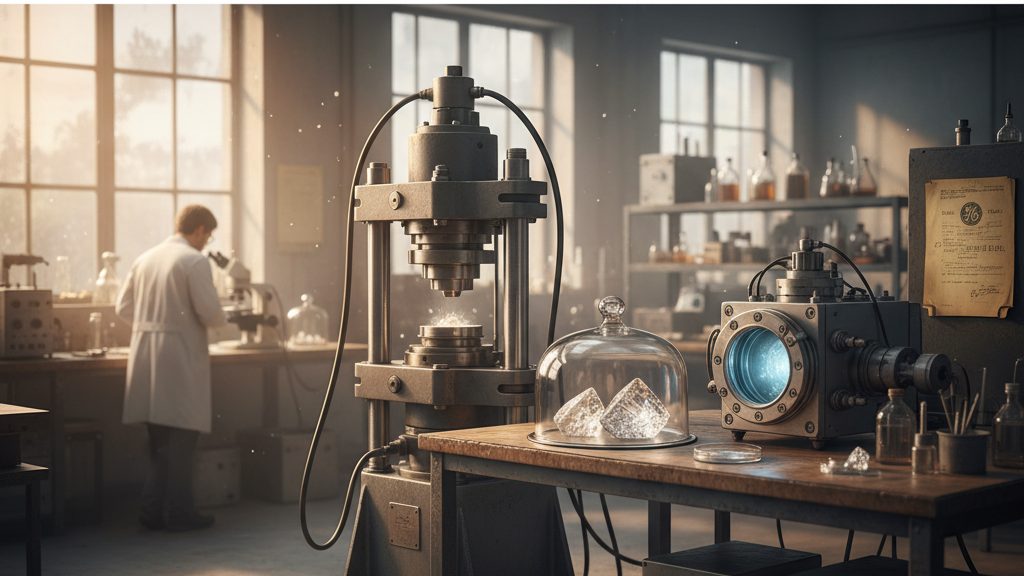
Laboratory diamonds are real diamonds, grown rather than mined. Their production history and the physics of how they form determine both their appearance and the tests used to identify them.
GE's Project Superpressure and two methods in a week
[01] In December 1954, General Electric's classified Project Superpressure, delayed from the 1940s by World War II, produced the first reproducible synthetic diamonds using H. Tracy Hall's custom press in a witnessed process.
[02] After years of research, General Electric suddenly possessed two possible diamond manufacturing methods in the space of a mere week.
HPHT like a jet on a fingertip, CVD at lower cost
[03] High-pressure high-temperature growth mimics Earth's mantle conditions at 5–6 GPa—roughly equivalent to a commercial jet airplane balanced on a fingertip—and temperatures of 1300–1600°C.
[04] In HPHT growth a diamond seed with carbon and metal catalyst is compressed by anvils, melting the carbon so it crystallizes in layers around the seed at temperatures of about 1500°C.
[05] The CVD method requires a lower upfront equipment cost than HPHT but may require subsequent treatment to improve the color of the grown diamonds.
Spectroscopy on the report, inclusions under the loupe, and a UV afterglow
[06] GIA uses spectroscopy and advanced testing to determine if a laboratory diamond grew via HPHT or CVD and records that growth method on its Laboratory-Grown Diamond Report.
[07] Magnification tools let skilled professionals spot metallic inclusions or telltale growth patterns in lab-grown diamonds, features absent from natural diamonds that instead contain tiny mineral crystals.
[08] HPHT laboratory-grown diamonds often exhibit strong phosphorescence under short-wave ultraviolet light, helping GIA identify laboratory origin through fluorescence patterns.
Even after decades of refinement, the ultraviolet afterglow and the metallic leftovers of the original process still mark a laboratory diamond as man-made.
[sources]
- https://www.labgrowndiamondscentre.com/blogs/blog/history-of-lab-grown-diamonds?srsltid=AfmBOopLbeBg4HbCYl3q7IqfquBjsgZpklXYXeFDXp4QoVQq8KBG815l
- https://rinconeducativo.org/en/anniversaries/july-25-2008-death-tracy-hall-first-person-manufacture-synthetic-diamonds
- https://keemtijewels.com/blogs/guide/lab-grown-diamonds-history?srsltid=AfmBOood_CIAqV8h1y-uwYuo_GnvW76XKafl-_11hu2xajAxQLoEPAN3
- https://www.sciencefriday.com/articles/diamond-fake-excerpt/
- https://www.gia.edu/gems-gemology/fall-2017-observations-hpht-grown-synthetic-diamonds
- https://regalhattongarden.co.uk/blogs/lab-diamonds/hpht-vs-cvd-key-differences-in-lab-diamonds
- https://stienhardt.com/blogs/lab-grown-diamond-insights/hpht-vs-cvd
- https://discover.gia.edu/GIALGDR
- https://www.gia.edu/hpht-and-cvd-diamond-growth-processes
- https://nationalpawnbrokers.org/2021/12/16/a-secure-way-to-buy-and-sell-laboratory-grown-diamonds
- https://www.gia.edu/gia-news-research/diy-fluorescence-guide-for-retailers
- https://www.londongold.com/education/can-you-detect-a-lab-grown-diamond