🤯 From Dying Stars to Fading Giants: Black Hole Origins, Cores and Leaks
by OMG[facts]
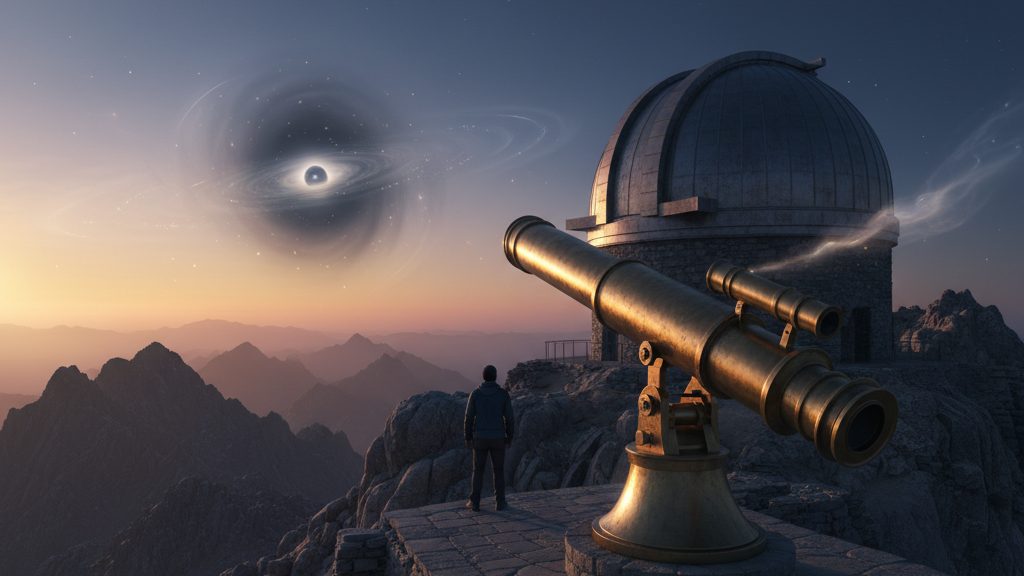
Black holes are among the universe's most compact objects, leftover from the ends of stellar lives and occupying the nuclei of galaxies. Their story runs from violent collapse through long-term growth to a slow quantum leak of energy. The verified findings below trace that arc without adding new claims.
Stellar black holes from core collapse
[01] Stellar black holes form in two ways: a massive star collapsing directly into a black hole without a supernova explosion, or an explosion in a proto-neutron star followed by collapse to a black hole.
[02] A large collection of detailed 3D core-collapse supernova simulations carried to late times identifies four distinct channels through which stellar-mass black holes can form.
[03] Astronomers have discovered stellar-mass black holes with masses in the range 5 to 30 solar masses, millions of which are present in each galaxy.
Supermassive black holes in galactic nuclei
[04] Observational work conducted over the past few decades indicates that all massive galaxies have supermassive black holes at their centres, with two ten-billion-solar-mass black holes at the centres of giant elliptical galaxies.
[05] Supermassive black holes appear as generic components of galactic nuclei based on secure detections of 10^6 to 10^{9.5} solar-mass dark objects at the centers of about a dozen galaxies, with mean mass of order 10^{-2.5} times the host galaxy mass.
[06] Recent observational and theoretical studies suggest supermassive black holes grow mostly through non-merger secular processes rather than mergers that dynamically grow galactic bulges, implying co-evolution over cosmic time.
Hawking radiation and thermodynamic instability
[07] In 1974 Hawking discovered that black holes emit radiation with a thermal power spectrum, and the total number of Hawking quanta emitted during evaporation of a Schwarzschild black hole is proportional to the square of the initial mass.
[08] Because black holes have negative specific heat they cannot be in stable thermal equilibrium except when additional energy is available, consistent with their emission of thermal radiation at nonzero temperature.
Even the largest of them will eventually radiate away what gravity once locked in.
[sources]
- https://arxiv.org/pdf/1609.08411
- https://arxiv.org/abs/1609.08411
- https://iopscience.iop.org/article/10.3847/1538-4357/addd04
- https://lweb.cfa.harvard.edu/~narayan/Benefunder/Narayan_McClintock.pdf
- https://www.nature.com/articles/nature10636
- https://ned.ipac.caltech.edu/level5/Merritt/Merritt1.html
- https://academic.oup.com/mnras/article/527/4/10855/7205544?login=false
- https://arxiv.org/pdf/1606.01790
- https://harvest.aps.org/v2/journals/articles/10.1103/PhysRevD.13.191/fulltext