🤯 Seawater Made Roman Concrete Stronger, Pompeii Lived on Street Food, Latrines Were Social
by OMG[facts]
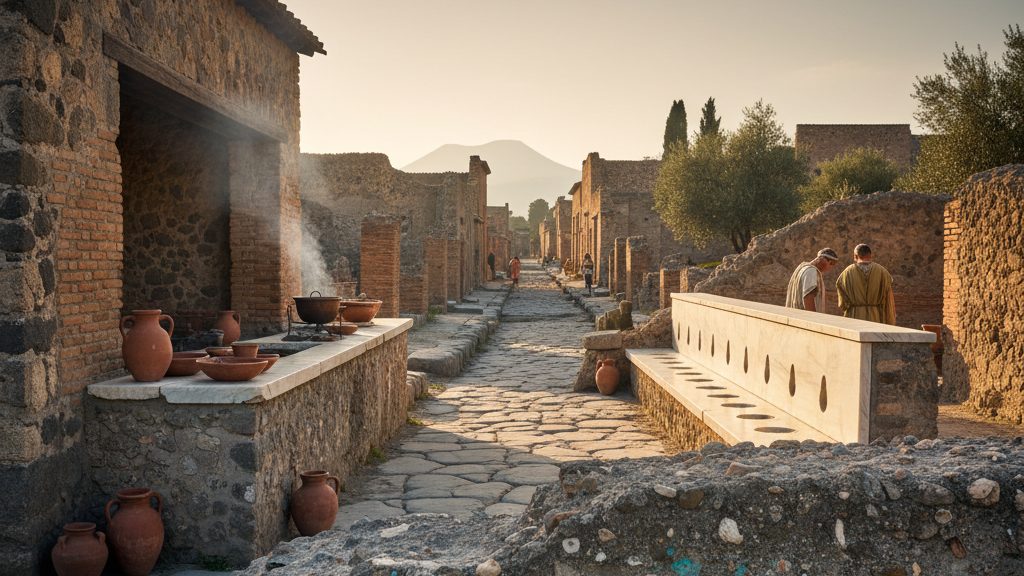
Roman cities mixed ambitious public works with dense everyday living. The materials they poured, the food sold at street fronts, and the toilets they shared all followed logics later ages largely forgot. Those systems make more sense when seen as they actually operated rather than as later cultures imagined them.
Harbors that keep sealing their own cracks
[01] Two-thousand-year-old Roman piers and breakwaters mixed from lime, volcanic ash and tuff packed into wooden forms now stand stronger than when first constructed as seawater grows reinforcing crystals.
source · source · source · source
[02] An international team studying ruins from four Italian Mediterranean sites found seawater reacting with volcanic ash continually grows new crystals that seal cracks, allowing the concrete to keep repairing itself.
Street-front hearths feeding ordinary Pompeians
[03] Frescoed thermopolia with in-built hearths at street fronts enabled Pompeii common folk to buy hot prepared meals, venues the Roman elite were less likely to visit.
[04] Pompeii had about eighty thermopolia and the first completely excavated stall still contained 2,000-year-old remnants of snails, fish and wine bought as hot ready meals by ordinary residents.
Benches for dozens, flushed by bath water
[05] Roman foricae used long marble or stone benches with regularly spaced keyhole openings that seated twenty to fifty people inches apart above a channel flushed by running water.
[06] Public foricae functioned as social spaces rather than private cubicles, with users sitting side-by-side as recycled bath water flushed waste via gutters into the sewers.
[07] Some evidence suggests foricae users cleaned themselves with a sponge-stick after scooping water from a gutter in front of the seats, though scholars still debate the practice.
The result is a Rome whose harbors improved with age, whose poor ate out, and whose toilets were never meant to be private.
[sources]
- https://www.labmanager.com/how-seawater-strengthens-ancient-roman-concrete-7086
- https://als.lbl.gov/learning-from-roman-concrete/
- https://newscenter.lbl.gov/2013/06/04/roman-concrete
- https://www.facebook.com/digitalkashmiri/posts/roman-concrete-keeps-repairing-itself-when-seawater-meets-volcanic-ash-in-the-mi/859716427006776
- https://www.pbs.org/wgbh/nova/article/mystery-of-ultrastrong-roman-concrete-solved
- https://www.nature.com/articles/nature.2017.22231.pdf
- https://www.facebook.com/digitalkashmiri/posts/roman-concrete-keeps-repairing-itself-when-seawater-meets-volcanic-ash-in-the-mi/859716427006776
- https://www.smithsonianmag.com/smart-news/fast-food-joint-pompeii-served-snails-fish-and-wine-new-finds-suggest-180976651
- https://www.theguardian.com/world/2020/dec/26/exceptionally-well-preserved-snack-bar-unearthed-in-pompeii
- https://www.facebook.com/groups/1355459141979445/posts/2225832608275423/
- https://www.brepolsonline.net/docserver/fulltext/food/2/1/J.FOOD.2.300273.pdf?accname=guest&checksum=5B557DEE82EEADB8A06C35B8D1CB7C9D&expires=1790698665&id=id
- https://www.theguardian.com/world/2019/mar/27/city-fast-food-bar-unearthed-in-pompeii-after-2000-years
- https://www.independent.co.uk/news/world/europe/pompeii-fast-food-italy-romans-b1779244.html
- https://www.brandeis.edu/magazine/2022/summer/featured-stories/sidebar-stories/latrines.html
- https://www.ancientrome.org/who-cleaned-roman-rome-the-social-economy-of-waste
- https://www.facebook.com/historyandarcheology/posts/ancient-roman-public-latrines-or-foricae-were-surprisingly-social-spaces-far-fro/1372429764926825/
- https://www.brandeis.edu/magazine/2022/summer/featured-stories/sidebar-stories/latrines.html
- https://bmcr.brynmawr.edu/2026/2026.02.28