🤯 Maya Symbols, Cheap Dots and the Horror Ban: Comics' Hidden Past
by OMG[facts]
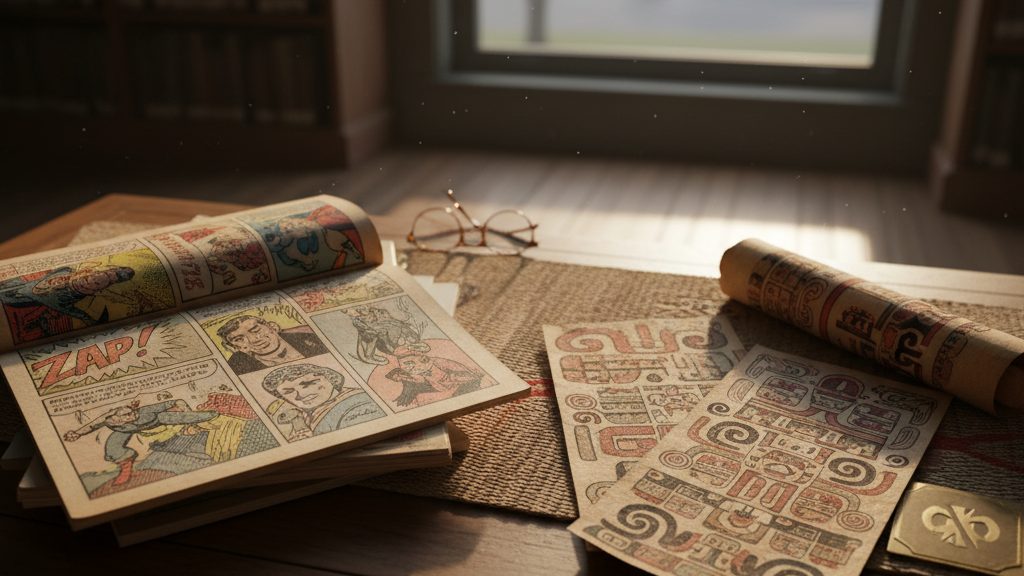
Comics sit at the meeting point of pictures, cheap reproduction, and public argument over what should appear on the page. Their visual language and their limits did not appear from nowhere. Older artistic conventions, industrial printing shortcuts, and moral campaigns all left marks that outlasted the newsstand.
Hand gestures as a symbolic language in Maya art
[01] Several prior studies of Maya art suggested that hand gestures formed part of a sophisticated symbolic language in which different motions conveyed specific meanings or stood for distinct forms of discourse.
Senate hearings and the 1954 Comics Code
[02] Dr. Frederick Wertham testified before 1954 Senate hearings on juvenile delinquency about his book Seduction of the Innocent, sparking the negative press that led publishers to adopt the Comics Code.
[03] The 1954 Comics Code stated that no comic magazine shall use the word horror or terror in its title and banned all scenes of horror, excessive bloodshed, gory or gruesome crimes.
Ben-Day dots from pulp pages to Pop Art
[04] US pulp comic books of the 1950s and 1960s used Ben-Day dots named after Benjamin Henry Day Jr. in cyan, magenta, yellow and black to inexpensively create shading and secondary colours such as green, purple, orange and flesh tones.
[05] Roy Lichtenstein began incorporating Ben-Day dots as early as 1962 in his print “Girl,” transforming the inexpensive comic-book printing technique into a hallmark of Pop Art paintings.
[06] Although phased out with the popularization of offset lithography, Ben-Day dots became a quintessential part of American pop culture and the imagery of the twentieth century.
Classic monsters permitted again in 1971
[07] In 1971 the Comics Code was revised to permit vampires, ghouls and werewolves when handled in the classic tradition such as Frankenstein, Dracula and high-calibre works by Edgar Allan Poe read in schools worldwide.
The same cheap dots that filled racks later defined museum walls, while the code that once forbade terror eventually made room for Dracula.
[sources]
- https://www.cambridge.org/core/journals/ancient-mesoamerica/article/reading-all-about-it-rethinking-orality-in-classic-maya-scribal-imagery/46BF5039EEE203448CAFCA7580D07689
- https://downthetubes.net/exploring-the-secret-history-of-ben-day-dots-in-us-comic-books
- https://andipaeditions.com/blog/229-lichtenstein-ben-day-dots-a-brief-exploration
- https://sites.udel.edu/materialmatters/2021/04/24/major-victory-in-a-minor-industry-the-genesis-of-the-american-superhero
- https://cbldf.org/the-comics-code-of-1954/
- https://en.wikipedia.org/wiki/Comics_Code_Authority
- https://guides.loc.gov/comic-books/comic-book-history
- https://hyperallergic.com/banned-horror-comics-back-from-the-dead
- https://cbldf.org/comics-code-revision-of-1971