🤯 Petra's Hidden Pipes, the Dead Sea's Abyssal Shore and Jordan's Refugee Reality
by OMG[facts]
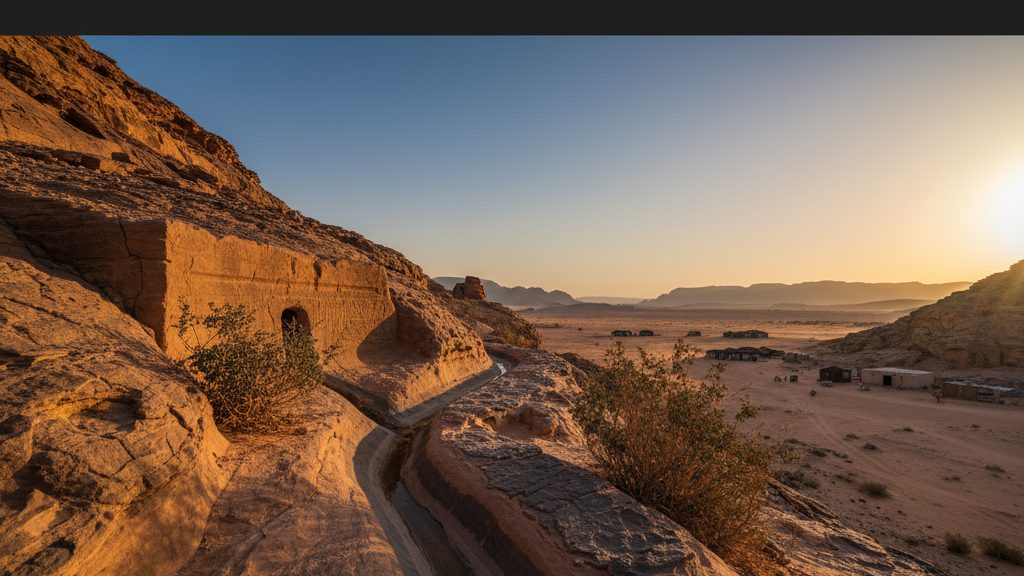
Jordan is a Middle Eastern country whose terrain and history have long demanded unusual solutions to scarcity and extremity. Ancient builders, distinctive natural features, and contemporary population movements all leave their mark on the same small territory. The facts that follow trace three of those marks in turn.
Petra’s waterworks in the desert
[01] Nabataean engineers constructed Petra’s sophisticated hydrological system of dams, cisterns and clay pipes from Wadi Musa springs between 400 BC and AD 400, enabling 30,000 to 40,000 inhabitants to flourish in extreme aridity.
[02] A highly sophisticated flash-flood prevention system of dams and stilling basins in Petra’s Siq, plus reservoirs and cisterns, regulated seasonal torrents from October to April and stored surface water in the arid landscape.
[03] The Siq, Ain Braq and Wadi Mataha pipeline systems used different design philosophies, including the Siq’s unique partial-flow technique, to meet Petra’s geophysical challenges and supply water to various urban sectors.
The Dead Sea’s depth, salt and name
[04] The Dead Sea, Earth’s lowest surface point at approximately 434 metres below sea level, is 9.6 times saltier than the oceans and the deepest hypersaline lake, plunging 300 metres.
[05] Christian monks named the Dead Sea after noticing the complete absence of life in its waters, where extreme salinity kills any fish carried in by floods and permits only bacteria to survive.
[06] The Dead Sea is the only hypersaline lake deep enough to form thermohaline stratification during summer, with buoyancy-driven flows coupled to salt precipitation and dissolution as its rapidly declining surface deposits salt year-round.
A country of refugees
[07] Jordan hosts more than three million refugees, primarily from Syria, Iraq, Yemen, Sudan and Somalia, with around 82 percent living in host communities and two camps holding about 120,000 people.
[08] Jordan has one of the world’s highest refugee-to-native population ratios, hosting more than 1.4 million Syrians despite only about 546,000 being officially registered with UNHCR as of April 2025.
Ancient pipes, a lifeless sea and millions of guests still define the same stretch of land.
[sources]
- https://www.asce.org/about-civil-engineering/history-and-heritage/historic-landmarks/petra
- https://medwinpublishers.com/AEOAJ/AEOAJ16000128.pdf
- https://www.mdpi.com/2073-4441/12/12/3498
- https://publication.doa.gov.jo/uploads/publications/24/SHAJ_9-315-324.pdf
- https://publication.doa.gov.jo/uploads/publications/25/SHAJ_10-291-310.pdf
- https://www.mdpi.com/2073-4441/18/13/1537
- https://www.mdpi.com/2073-445x/11/4/549
- https://par.nsf.gov/servlets/purl/10611184
- https://www.noaa.gov/jetstream/dead-max
- https://www.britannica.com/place/Dead-Sea
- https://www.migrationpolicy.org/journal/feature/fragile-yet-unmistakable-long-term-integration-syrian-refugees-jordan
- https://cgspace.cgiar.org/server/api/core/bitstreams/67b0b795-9022-4482-9d6b-9fee7716dfb3/content