🤯 Blue Blood, Mini-Brains & Instant Skin: Why Octopuses Feel Like Aliens
by OMG[facts]
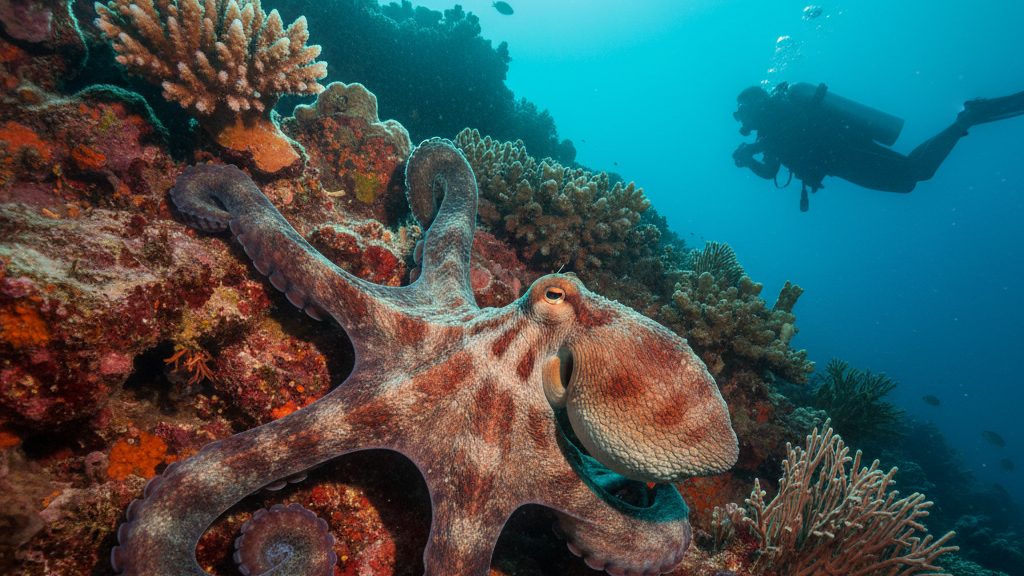
Octopuses occupy a biological niche that has produced some of the most unusual body plans in the animal kingdom. They rely on chemistry and neural architecture unlike those of most other creatures, giving them abilities that look almost engineered. Those systems keep oxygen moving through cold water, let decisions happen at the periphery, and rewrite appearance on demand.
Three Hearts Pumping Copper Blood
[01] Two branchial hearts sitting at the base of each gill push oxygen-poor blood through the gills to recharge it, while one systemic heart then pumps copper-based hemocyanin that turns octopus blood a striking blue.
[02] Haemocyanin concentrations reach 89 milligrams per millilitre in Megaleledone setebos, and Enteroctopus dofleini generates 5.3 to 9.3 kilopascals of blood pressure, values high for invertebrates that aid cold-water oxygen delivery.
[03] Octopus haemocyanin has undergone functional modifications under positive selection that sustain oxygen release at low temperatures, a key reason copper blood works in icy, oxygen-poor seas.
A Nervous System Built Into the Arms
[04] The central brain between an octopus’s eyes contains about 180 million neurons that decide needs such as searching for food, while the eight arms together hold even more neurons in large axial nerve cords.
[05] Around two-thirds of an octopus’s nerve cells are distributed among the arms, allowing those flexible appendages to operate semi-independently and even taste objects they touch.
[06] Each octopus arm gathers sensory information to drive its own movements and even those of other arms without consulting major brain regions, functioning like a partly independent mini-brain.
Skin That Matches Colour and Texture Instantly
[07] Octopuses match colour, reflectivity and three-dimensional texture in a fraction of a second by coordinating three layers of specialized skin cells, including thousands of chromatophores and light-reflecting iridophores.
[08] Chromatophore expansion costs octopuses a median 12.5 nanomoles of oxygen per square millimetre of skin per hour, revealing that their rapid camouflage is metabolically expensive.
Together those systems make an octopus less a single animal than a distributed, shape-shifting organism built for the ocean floor.
[sources]
- https://www.scienceabc.com/nature/animals/why-do-squids-and-octopuses-have-blue-blood
- https://www.facebook.com/Discovery/posts/happy-worldoctopusday-from-a-true-master-of-disguise-didyouknow-octopuses-have-b/1250279467145303/
- https://pmc.ncbi.nlm.nih.gov/articles/PMC4403823
- https://pmc.ncbi.nlm.nih.gov/articles/PMC4491423
- https://www.sciencenews.org/article/octopus-taste-touch-arm-suckers
- https://www.ecoticias.com/en/octopuses-have-nine-brains-three-hearts-and-blue-copper-based-blood-and-most-of-their-neurons-live-in-their-arms-meaning-each-arm-can-taste-decide-and-react-on-its-own/33372
- https://www.scientificamerican.com/article/how-octopus-arms-bypass-the-brain
- https://sites.nd.edu/biomechanics-in-the-wild/2021/04/07/nine-brains-are-better-than-one-an-octopus-nervous-system
- https://biologicalsciences.uchicago.edu/news/octopus-arms-segmented-nervous-system
- https://scienceinsights.org/how-do-octopuses-camouflage-color-texture-and-speed
- https://ocean.si.edu/ocean-life/invertebrates/how-octopuses-and-squids-change-color
- https://pmc.ncbi.nlm.nih.gov/articles/PMC9590006/
- https://pmc.ncbi.nlm.nih.gov/articles/PMC11621519