🤯 Chicago Disassembly Lines to Antarctic Kitchens: Extreme Food Facilities
by OMG[facts] / Orizu obianuju
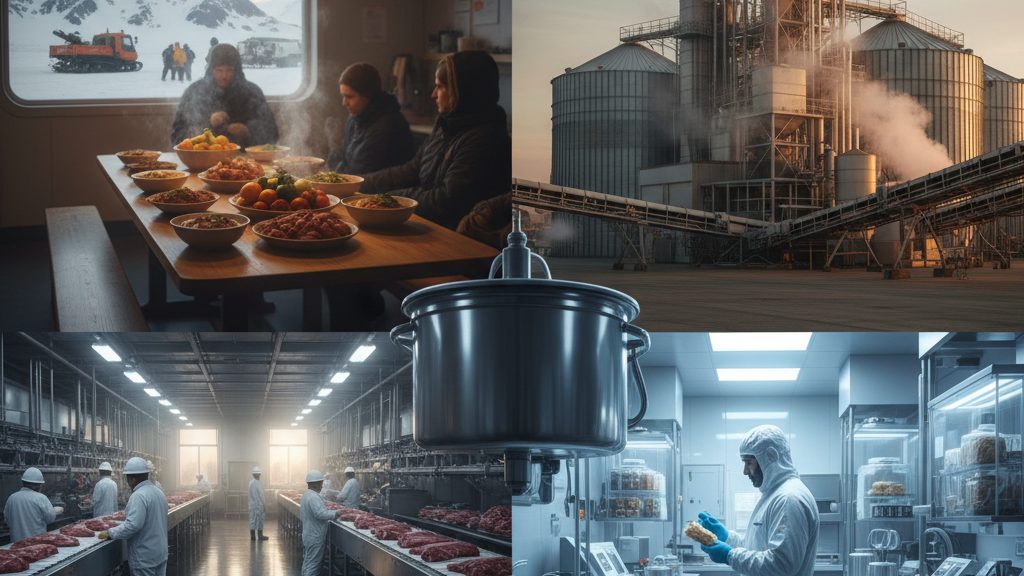
Feeding people at industrial scale or in environments where ordinary kitchens cannot operate has required specialized food facilities. Those operations range from livestock processing plants to systems built for orbit and polar isolation. The methods developed for each setting have little in common except the need to keep people fed under conditions far from a conventional kitchen.
Disassembly lines and the Union Stock Yards
[01] Disassembly-line techniques for turning livestock into meat began very early in Cincinnati but were used so effectively in Chicago that the stockyards became a lasting tourist attraction.
[02] President Theodore Roosevelt submitted a 1906 report on Chicago's Union Stock Yards to Congress after Upton Sinclair's novel The Jungle exposed meatpacking conditions, helping create the Pure Food and Drug Act.
NASA freeze-dried meals for microgravity
[03] The Space Food Systems Laboratory at NASA's Johnson Space Center produces freeze-dried meals and seals powdered beverages in containers fitted with a one-way plastic valve so water can be added in microgravity.
[04] ISS and Space Shuttle astronauts were issued about 1.8 kilograms of food plus packaging each day, featuring a higher share of thermostabilized meals than Apollo-era systems.
Antarctic station kitchens and the Polarstern
[05] Every expeditioner at Australian Antarctic stations takes a turn on the kitchen slushy roster in commercially equipped facilities with gas cooking, where vegetarian, vegan and gluten-intolerant diets are fully provided.
[06] The German polar research and supply vessel Polarstern was designed to annually resupply the German Antarctic program in addition to carrying out polar research missions.
The same pressures of scale and isolation that built the stockyards now shape how food is produced and served in orbit and on the ice.
[sources]
- https://history.house.gov/Records-and-Research/Listing/c_042
- https://open.mitchellhamline.edu/cgi/viewcontent.cgi?article=1819&context=wmlr
- https://history.house.gov/HouseRecord/Detail/15032448817
- https://www.npr.org/sections/thesalt/2015/12/03/458314767/how-chicago-s-slaughterhouse-spectacles-paved-the-way-for-big-meat
- https://www.nasa.gov/directorates/esdmd/hhp/space-food-systems/
- https://spacecenter.org/space-food-from-creation-to-consumption/
- https://ift.onlinelibrary.wiley.com/doi/10.1111/j.1750-3841.2010.01982.x
- https://www.antarctica.gov.au/antarctic-operations/stations-and-field-locations/amenities-and-operations/food
- https://nsf-gov-resources.nsf.gov/attachments/114452/public/oac_resupply_report_081205.pdf